What can site-resolved images of currents and fluctuations tell us about strongly interacting bosons in optical lattices?
The platform
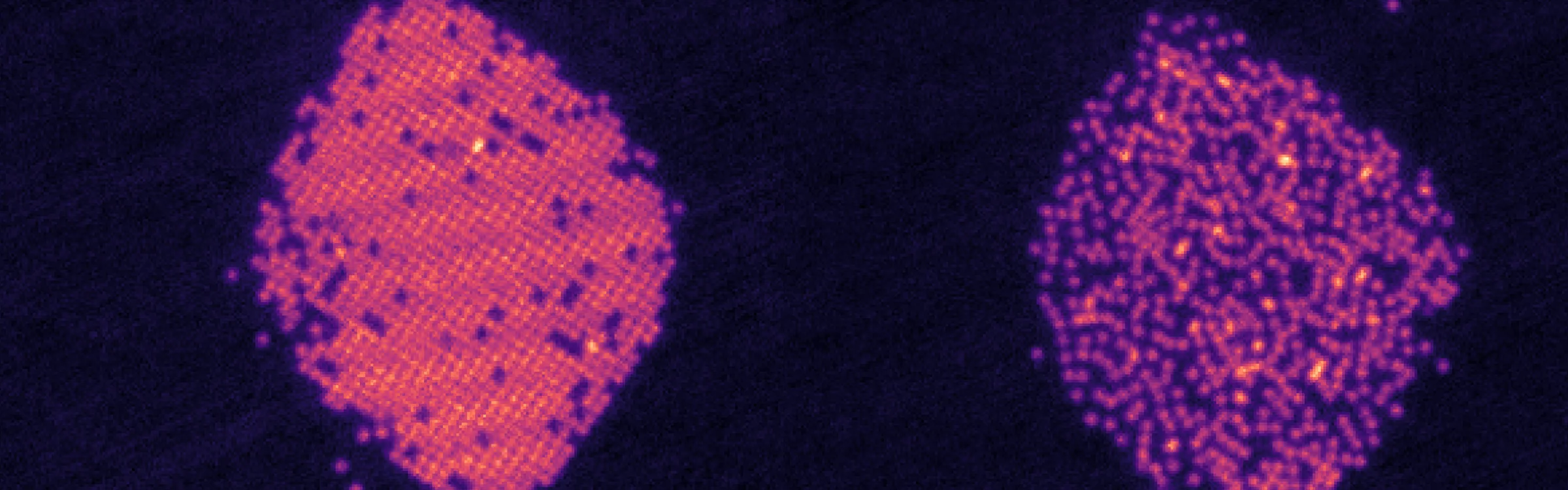
We operate a quantum gas microscope for bosonic ¹³³Cs atoms at LMU, together with Monika Aidelsburger’s group. Two-dimensional optical superlattices with short and long spacings of 383.5 nm and 767 nm hold the atoms, and a 0.8 NA objective images them by fluorescence. The short spacing is less than half the Rayleigh resolution of about 850 nm, so a deep neural network reconstructs the occupation of each site. A digital micromirror device projects programmable potentials, a Feshbach resonance tunes the contact interactions, and laser-assisted tunnelling imprints a synthetic magnetic flux.
Single atoms closer than the imaging resolution
Our lattice spacing is less than half the imaging resolution, so the light from neighbouring atoms overlaps on the camera. To read out the occupation of each site, we developed a deep convolutional neural network that learns directly from experimental fluorescence images, without labelled training data. It reconstructs images with several thousand lattice sites and reaches fidelities of about 96 % or better at all fillings.
 Enlarge (opens the full-size figure)
Fluctuations and return probabilities in quantum dynamics
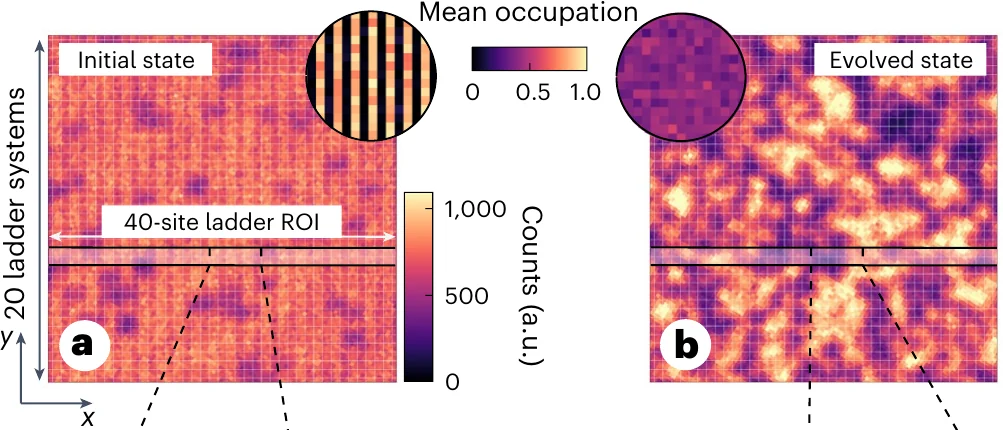
We asked whether large-scale fluctuations in an isolated quantum system are described by fluctuating hydrodynamics, a framework developed for classical stochastic systems. Starting from a charge-density wave of hard-core bosons in 20 independent ladders of up to 2 × 50 sites, we recorded the full counting statistics of the atom number in subsystems as the system evolved. By tuning the coupling between the two legs, we moved from integrable chains, where fluctuations grow ballistically, to chaotic ladders, where they grow diffusively. In the chaotic case the growth of fluctuations followed the predictions of fluctuating hydrodynamics, and the diffusion constant we extracted from it agreed with equilibrium linear-response estimates.
In a 2025 preprint we measure a subsystem Loschmidt echo, the probability that a subsystem returns to its initial configuration. In a one-dimensional Bose-Hubbard chain it reveals a dynamical quantum phase transition at short times. At long times it measures the effective dimension of the Hilbert space the system explores and shows ergodicity breaking caused by Hilbert-space fragmentation.
 Enlarge (opens the full-size figure)
Currents in synthetic magnetic fields
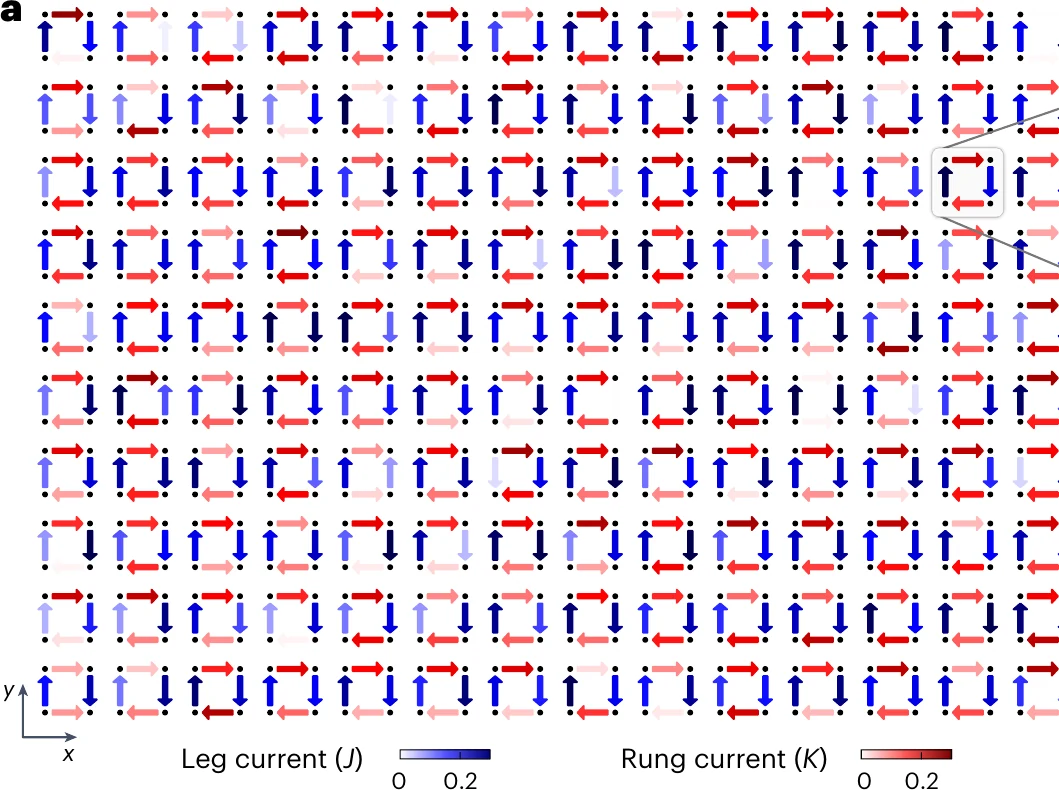
Quantum gas microscopes usually record only where atoms sit. We isolate pairs of sites in double wells and rotate the measurement basis, which gives us particle currents and kinetic energy on individual bonds. Laser-assisted tunnelling adds a synthetic magnetic flux of π/2 per plaquette. With both tools we realised the strongly interacting Mott-Meissner phase in bosonic flux ladders of 48 sites at half filling, imaged its chiral currents with local resolution and found the interaction-induced suppression of the chiral current that is characteristic of this phase.
 Enlarge (opens the full-size figure)
A U(1) quantum spin liquid from non-equilibrium dynamics
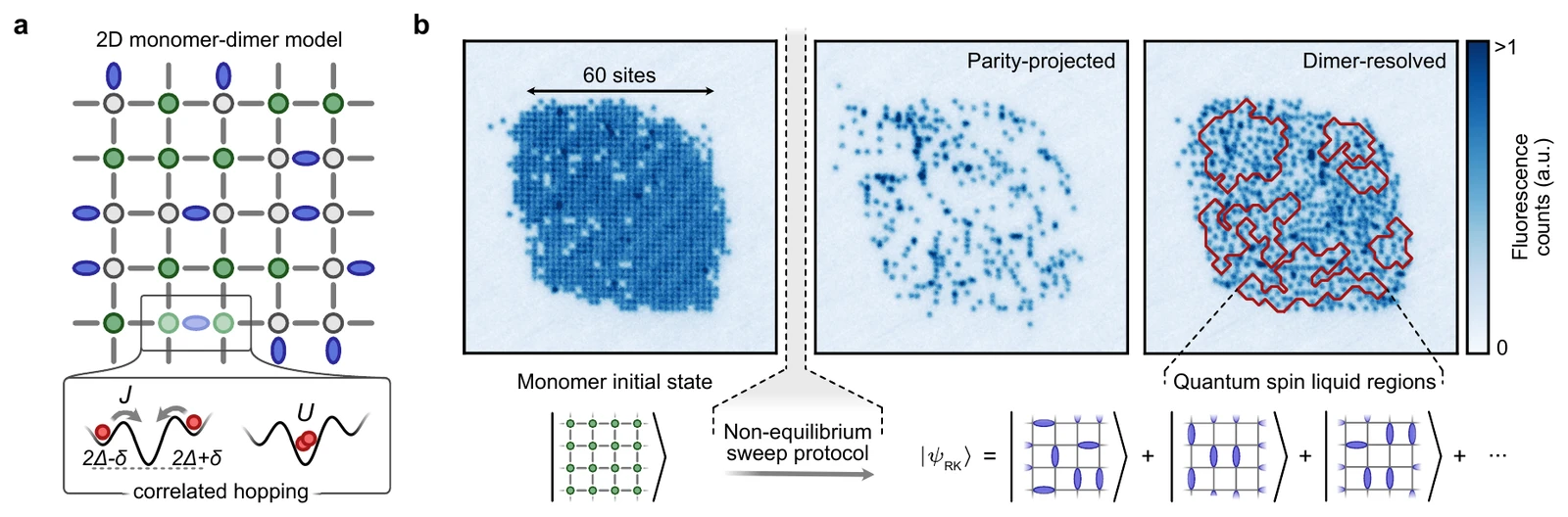
In a 2026 preprint we realise a two-dimensional U(1) lattice gauge theory on more than 3,000 lattice sites. In a tilted square superlattice with a large staggered potential, atoms can only tunnel in pairs: two atoms on neighbouring high-energy sites (monomers) hop together and form a doubly occupied site (a dimer) on the link between them. This kinetically constrained dynamics maps onto a monomer-dimer model, equivalent to a quantum link model of quantum electrodynamics in two dimensions with dynamical matter, which obeys a Gauss’s law at every vertex. A new imaging step converts doubly occupied sites into single atoms with 98(1) % fidelity, so monomers and dimers appear in the same snapshot and we can check Gauss’s law directly after a quench.
Starting from a crystal of monomers, we ramp the monomer mass from negative to positive values. A semi-adiabatic ramp, slow compared with monomer excitations but fast compared with the tiny energy splittings between dimer coverings, turns most monomers into dimers. It prepares regions in an equal-amplitude superposition of all dimer coverings, the Rokhsar-Kivelson state of a U(1) quantum spin liquid, although our Hamiltonian does not host this state as its ground state.
 Enlarge (opens the full-size figure)
Pinch points and many-body coherence
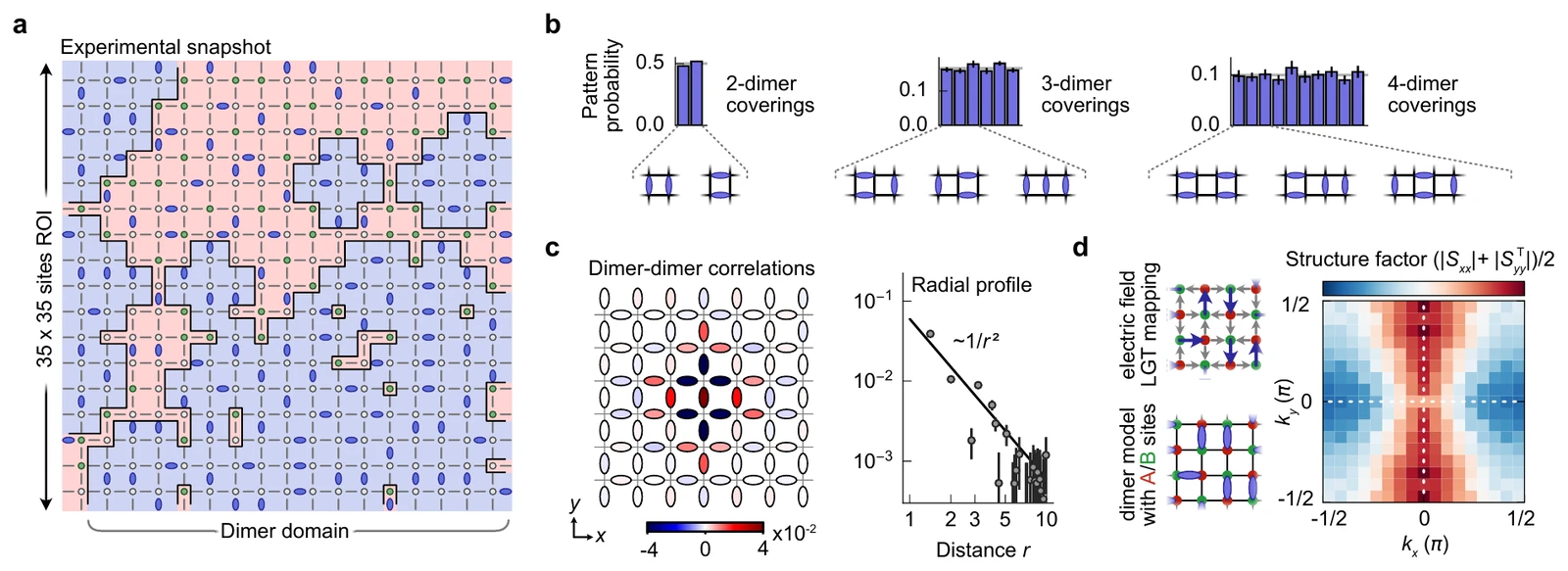
After the ramp, 83.2(2) % of the vertices fulfil Gauss’s law. Within regions of near-perfect dimer covering, all distinct local dimer patterns occur with about equal probability, as expected for the Rokhsar-Kivelson state. Dimer-dimer correlations are consistent with the 1/r² decay expected for this critical state, and the electric-field structure factor shows a pinch point at zero momentum, the momentum-space signature of Gauss’s law known from neutron scattering on spin ice.
An incoherent mixture of dimer coverings would show the same signatures. To test coherence, we reverse the ramp: only a coherent superposition returns efficiently to the monomer crystal, and large monomer patches reappear in the images. A short dephasing pulse before the reverse ramp suppresses these patches, and imprinting a phase between horizontal and vertical dimers makes the return probability oscillate. From the round-trip snapshots we find coherent spin-liquid regions extending over about 100 lattice sites.
 Enlarge (opens the full-size figure)
Research directions
Next we want to study how excitations move in two-dimensional lattice gauge theories and add plaquette interactions through a hybrid digital-analogue scheme. Extending flux ladders to many legs is a route towards fractional Chern insulators in two dimensions, and we plan to use subsystem Loschmidt echoes in two-dimensional systems as well.
Selected results & publications
Dynamical preparation of U(1) quantum spin liquids in an analogue quantum simulatorarXiv:2604.24744 (2026) · PreprintStrongly interacting Meissner phases in large bosonic flux laddersNature Physics 21, 895–901 (2025) · Journal ArticleEmergence of fluctuating hydrodynamics in chaotic quantum systemsNature Physics 20, 1732–1737 (2024) · Journal ArticleLocal readout and control of current and kinetic energy operators in optical latticesPhysical Review Letters 133, 063401 (2024) · Journal ArticleAn unsupervised deep learning algorithm for single-site reconstruction in quantum gas microscopesCommunications Physics 6, 166 (2023) · Journal ArticleResearch with this team
Discuss student projects, doctoral research or postdoctoral opportunities with the scientific contact; project scope and availability are agreed individually.
Methods and topics: Quantum gas microscopy, Optical lattices, Synthetic magnetic flux, Single-site reconstruction.
Explore research opportunities