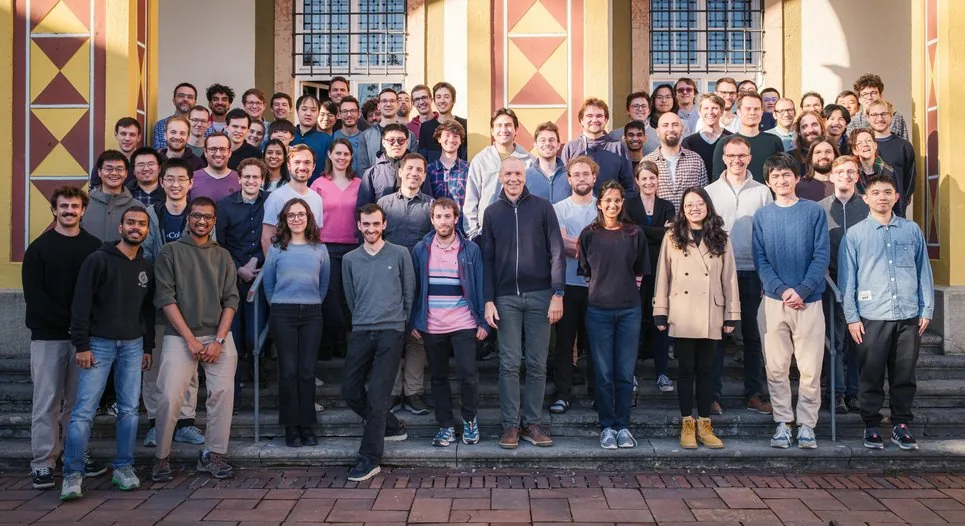
These are the scientific directions of our experiment teams. Student, doctoral and postdoctoral projects are shaped individually; a listed direction is not a specific vacancy. Contact the team about the science and use the application guidance above to enquire about joining.
MPQ · Garching
How do spin and charge correlations evolve when a Mott insulator is doped?
Relevant methods: Quantum gas microscopy, Optical lattices, Correlation analysis.
Scientific enquiries: Titus Franz
MPQ · Garching
Can a simple cryogenic apparatus hold large strontium atom arrays for hours and turn them into a quantum simulator for XXZ magnets?
Relevant methods: Cryogenic vacuum systems, Optical tweezers, Optical lattices, Circular Rydberg states, Strontium laser cooling, Single-atom detection.
Scientific enquiries: Max Melchner von Dydiowa
MPQ · Garching
How can the optical clock transition of strontium become a fast, high-fidelity qubit for a neutral-atom quantum computer?
Relevant methods: Optical tweezers, Optical clock qubits, Rydberg excitation, Optimal control.
Scientific enquiries: Andrea Alberti
MPQ · Garching
What happens to a Fermi gas when its particles interact through strong, long-range and anisotropic dipolar forces?
Relevant methods: Laser cooling, Microwave control, Molecular collisions.
Scientific enquiries: Xin-Yu Luo
MPQ · Garching
How does complex quantum many-body behaviour emerge from interactions between individual atoms?
Relevant methods: Quantum gas microscopy, Rydberg excitation, Light–matter interactions.
Scientific enquiries: Pascal Weckesser
LMU · Munich
What can site-resolved images of currents and fluctuations tell us about strongly interacting bosons in optical lattices?
Relevant methods: Quantum gas microscopy, Optical lattices, Synthetic magnetic flux, Single-site reconstruction.
Scientific enquiries: Immanuel Bloch
MPQ · Garching
How can large, continuously refilled arrays of strontium atoms become programmable quantum processors?
Relevant methods: Optical lattices and tweezers, Rydberg excitation, Coherent control.
Scientific enquiries: Johannes Zeiher
MPQ · Garching
How can controlled motion and collisions turn a fermionic quantum simulator into a programmable processor?
Relevant methods: Coherent atom control, Optical superlattices, Quantum algorithms.
Scientific enquiries: Immanuel Bloch