How do spin and charge correlations evolve when a Mott insulator is doped?
The platform
Our quantum gas microscope works with a two-component Fermi gas of ⁶Li atoms in a single plane of an optical lattice. Within the plane, 532 nm light forms a square lattice with a spacing of about 1.1 µm. Adding a 1064 nm lattice with twice this spacing groups neighbouring sites into double wells. A digital micromirror device shapes the confinement, and a Feshbach resonance tunes the interactions. Before fluorescence imaging we separate the two spin states into different planes, so each snapshot records spin and charge on every site.
Pairs and stripes of holes
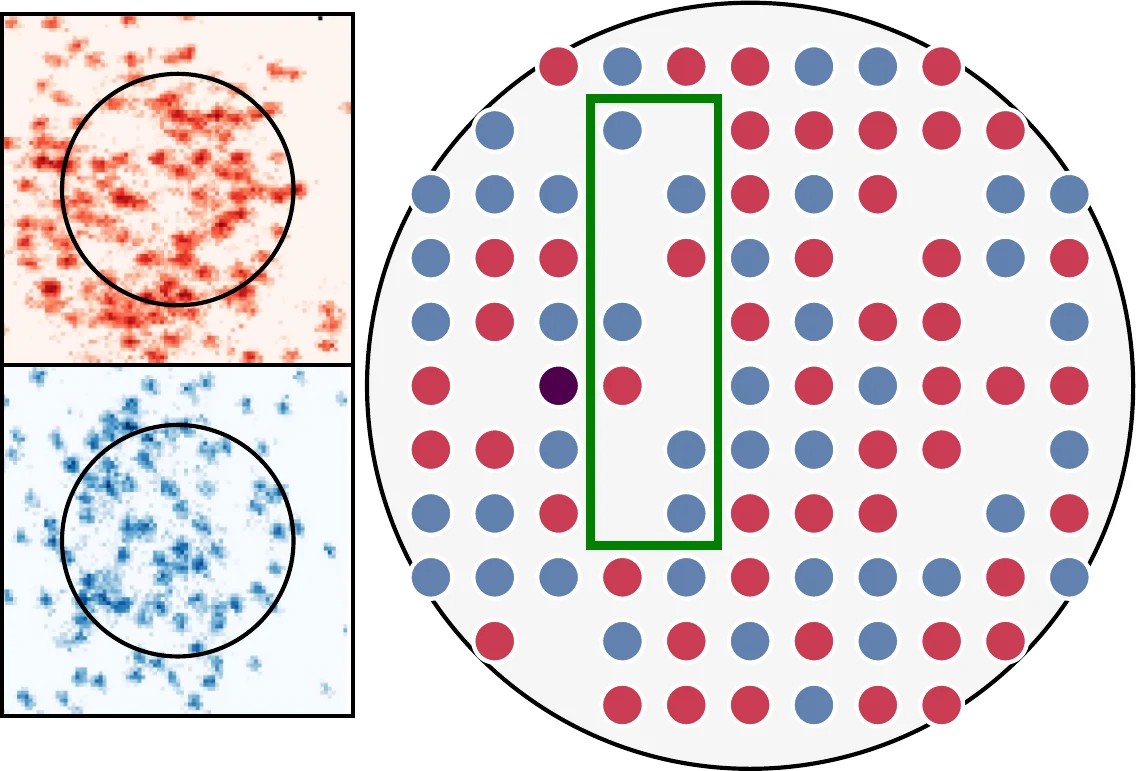
Removing atoms from a Mott insulator leaves holes that move through an antiferromagnetic background. In ladders with mixed-dimensional couplings, an energy offset between the two legs suppresses tunnelling along the rungs but keeps the spin exchange. Pauli blocking no longer keeps two holes on the same rung apart. Holes then bind into pairs, mostly on the same rung, with a binding energy on the order of the superexchange energy.
We then raised the potential on every other chain of a two-dimensional system. Holes now attract each other beyond nearest neighbours, and extended lines of holes appear more often than for randomly placed holes. Spin correlations up to third order are consistent with an antiferromagnetic domain wall across these lines. We interpret this as individual stripes beginning to form.
 Enlarge (opens the full-size figure)
Magnetism at the onset of the pseudogap
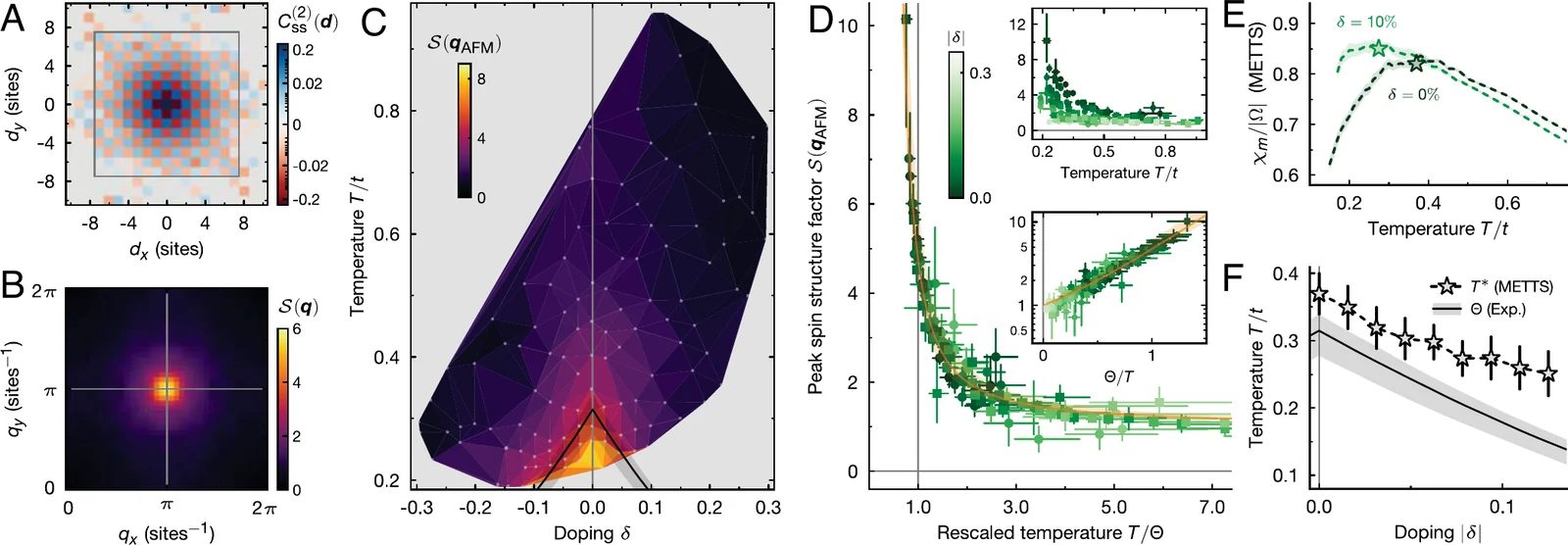
In the two-dimensional Fermi-Hubbard model we measured spin and charge correlations for dopings up to 30 % on either side of half filling and temperatures from about 0.2 to 1 times the tunnelling energy. When temperature is rescaled by a doping-dependent scale, the antiferromagnetic correlations follow a single universal curve. Numerical simulations show that this scale is comparable to the pseudogap temperature.
A 2026 preprint led by theory colleagues combines our data with numerical simulations to study entanglement in this regime. Nearest-neighbour spin-singlet entanglement appears only as the pseudogap sets in and, unlike classical correlations, stays confined to neighbouring sites. This constrains microscopic models of the pseudogap.
 Enlarge (opens the full-size figure)
Collisional gates for fermions
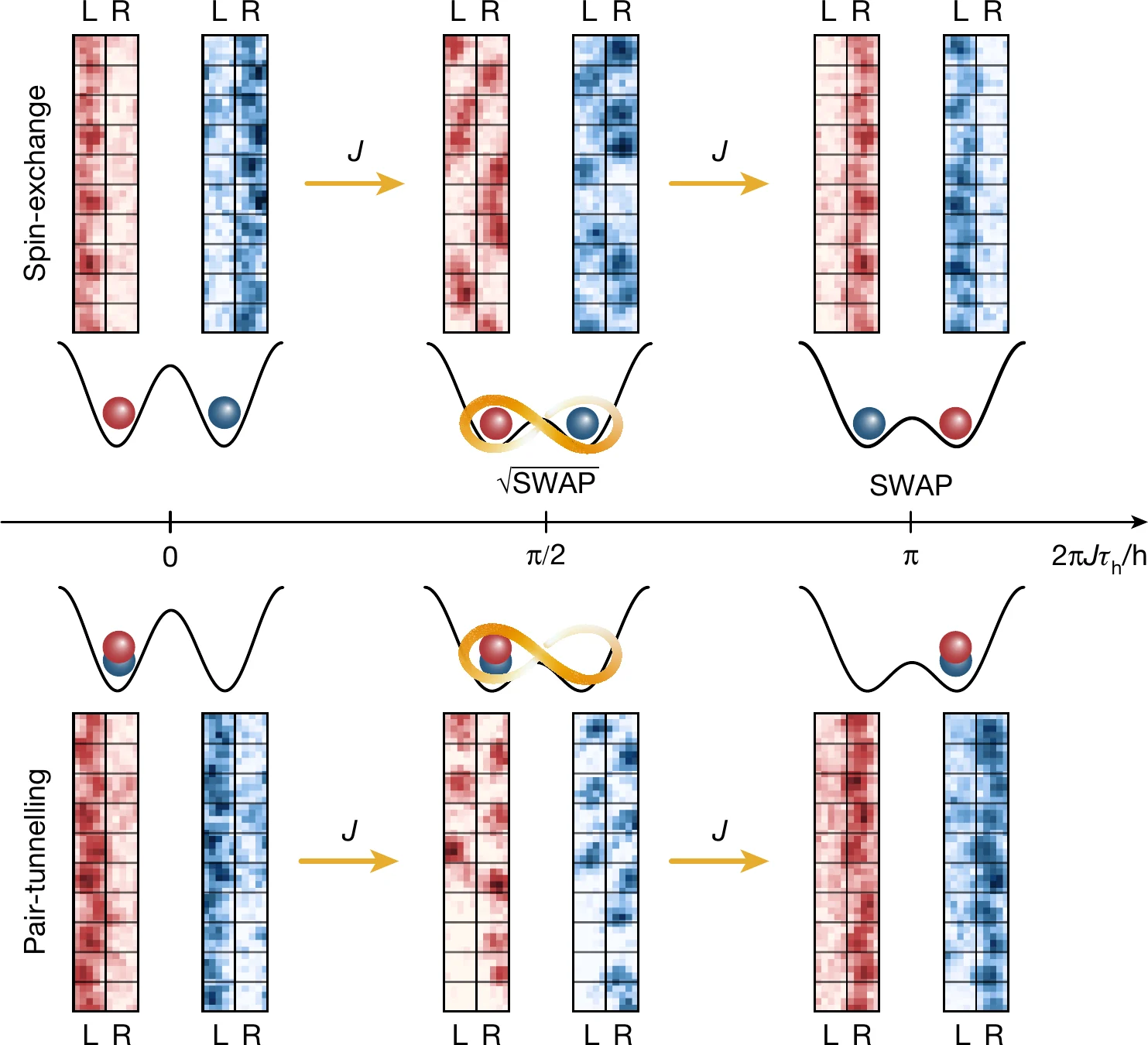
When we lower the barrier of a superlattice double well, two atoms of opposite spin exchange their spins through a controlled collision, and a doubly occupied site tunnels as a pair. Timing these processes gives entangling √SWAP gates with fidelities up to 99.75(6) % and Bell states with an estimated coherence time of more than 10 s. A composite sequence isolates coherent pair tunnelling, a building block for quantum chemistry simulations.
 Enlarge (opens the full-size figure)
Symmetry breaking in measured states
In a 2026 preprint we imaged one spin component of a weakly interacting Fermi gas on about 196 sites. Each snapshot is then a fully dephased state of spinless fermions. Using a machine-learned reference state, we estimate nonlinear (Rényi) correlators from the snapshots, which show long-range order of a kind called strong-to-weak spontaneous symmetry breaking. A commensurate superlattice drives a metal-to-insulator transition that, after dephasing, appears as a sharp transition of this kind.
Research directions
We want to look for pairing among dopants at lower temperatures, study the stripe phase in mixed dimensions, and combine collisional gates with analogue evolution to prepare and read out correlated states.
Selected results & publications
Emergence of spin entanglement with the pseudogap onset in the Fermi-Hubbard modelarXiv:2605.31240 (2026) · PreprintObservation of Strong-to-Weak Spontaneous Symmetry Breaking in a Dephased Fermi GasarXiv:2604.16137 (2026) · PreprintHigh-fidelity collisional quantum gates with fermionic atomsNature 652, 602–608 (2026) · Journal ArticleObservation of emergent scaling of spin–charge correlations at the onset of the pseudogapPNAS 123, e2525539123 (2026) · Journal ArticleFormation of individual stripes in a mixed-dimensional cold-atom Fermi-Hubbard systemNature 637, 57–62 (2025) · Journal ArticleMagnetically mediated hole pairing in fermionic ladders of ultracold atomsNature 613, 463–467 (2023) · Journal ArticleResearch with this team
Discuss student projects, doctoral research or postdoctoral opportunities with the scientific contact; project scope and availability are agreed individually.
Methods and topics: Quantum gas microscopy, Optical lattices, Correlation analysis.
Explore research opportunities