How can the optical clock transition of strontium become a fast, high-fidelity qubit for a neutral-atom quantum computer?
The platform
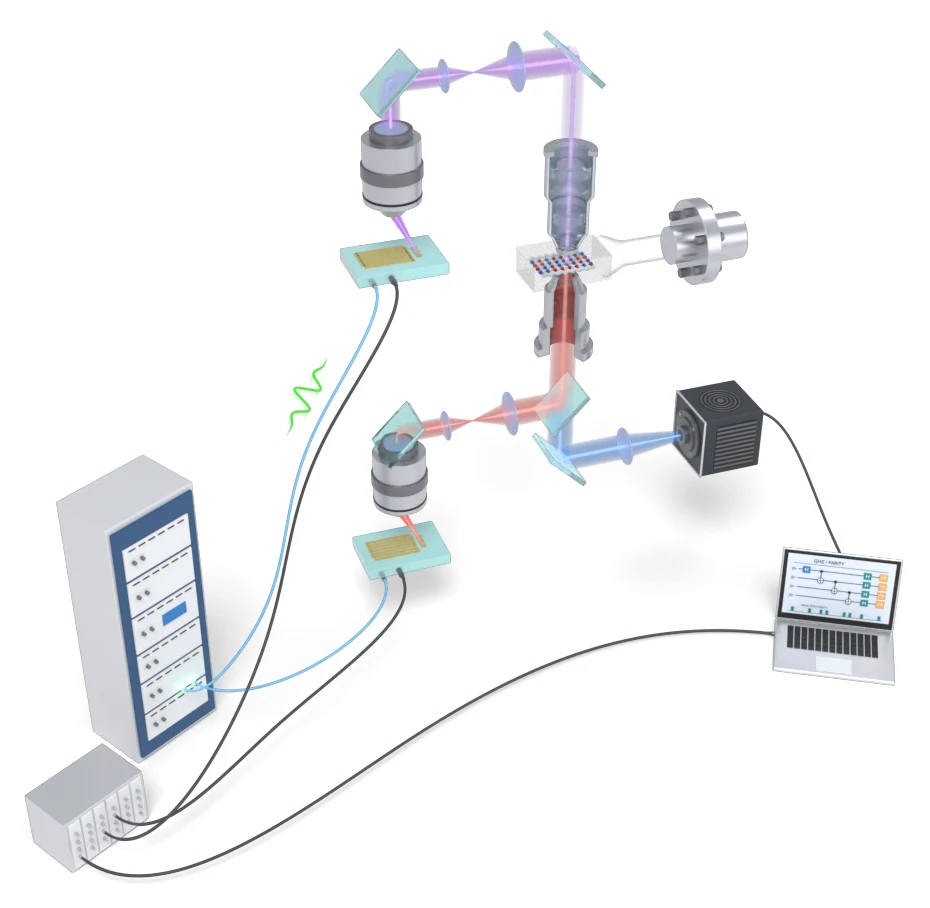
Our M1 machine is the neutral-atom quantum computing demonstrator of Munich Quantum Valley. It holds single ⁸⁸Sr atoms in optical tweezers. The qubit is stored in the ground state ¹S₀ and the long-lived clock state ³P₀, which a narrow clock laser at 698 nm couples directly. Ultraviolet light at 317 nm excites atoms from ³P₀ to Rydberg states, whose strong interactions entangle neighbouring qubits, and fluorescence on the 461 nm transition reads out the atoms. The same team built a second machine with a cryogenic vacuum system, described on the Sr Cryo Lab page.
Gates without photon recoil
An optical qubit absorbs the momentum of the photon that drives it. In a trap, this recoil can entangle the qubit with the motion of the atom and heat it, which lowers the fidelity of the gate and of every gate that follows. In deep traps most of the recoil is taken up by the trap, as in the Mössbauer effect, but not all of it.
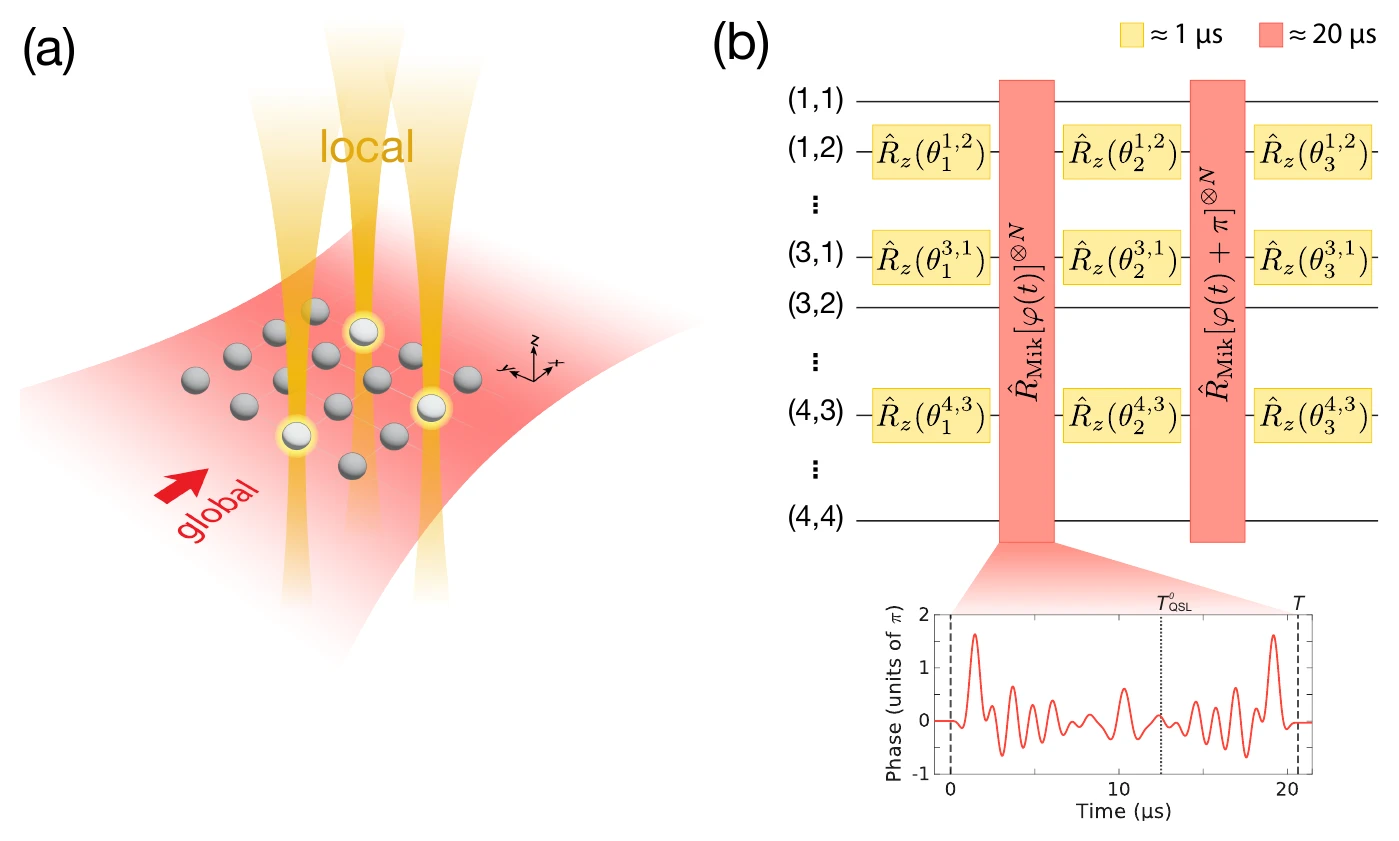
In a 2024 preprint we proposed recoil-free pulses: by modulating the phase of the clock laser in time, the motion of the atom returns to where it started. This holds for any qubit state and for motional Fock and coherent states, and it suppresses the effect of recoil by three orders of magnitude compared with ordinary pulses. Composite “Mikado” pulses built from them are also robust against variations of the laser intensity and the resulting light shift. Global Mikado pulses combined with local phase rotations by light shifts give arbitrary single-qubit gates on all atoms of an array in parallel. This opens the way to more than 1000 gates with an overall fidelity above 99 %.
 Enlarge (opens the full-size figure)
Fast gates despite thermal motion
With time-optimal control we derived bang-bang pulses that remove photon recoil while shortening the gate by about 20 times compared with conventional pulses. Even without recoil, the thermal motion of the atom in the trap becomes entangled with the qubit and sets a lower bound on the gate error. This bound does not depend on the Rabi frequency, so working in the resolved-sideband regime does not remove it. Smooth-phase pulses overcome the bound and reduce the gate error by more than an order of magnitude for typical thermal atoms, and they can be refined to compensate for laser inhomogeneities. We tested these pulses in simulations of single-qubit gates on the clock transition of ⁸⁸Sr atoms in an optical tweezer array.
Finding atoms in fluorescence images
Preparing and reading out qubits starts with deciding, from a fluorescence image, which tweezers hold an atom. Together with Jonas Winklmann and Martin Schulz we compared detection algorithms on simulated images with known occupation, both for precision and for run time, and against the Cramér-Rao bound that no estimator can beat. A global non-linear least-squares fit that uses the point-spread function of the imaging system performed best, but it is computationally expensive. Where speed matters most, simpler algorithms can be preferable.
Research directions
We aim to combine fast single-qubit gates on the optical clock transition with Rydberg two-qubit gates and parallel atom transport, so that quantum circuits can run on the M1 demonstrator and be accessed remotely. In the cryogenic machine we work towards larger arrays and longer storage times.
Selected results & publications
Recoil-free Quantum Gates with Optical QubitsarXiv:2408.04622 (2024) · PreprintMotion-insensitive time-optimal control of optical qubitsQuantum Science and Technology 10, 035025 (2025) · Journal ArticleComparison of Atom Detection Algorithms for Neutral Atom Quantum Computing2024 IEEE International Conference on Quantum Computing and Engineering (QCE), 1048–1057 (2025) · Conference PaperA cryogenic neutral-atom platform with full optical access and 2-hour trap lifetimearXiv:2607.12988 (2026) · PreprintResearch with this team
Discuss student projects, doctoral research or postdoctoral opportunities with the scientific contact; project scope and availability are agreed individually.
Methods and topics: Optical tweezers, Optical clock qubits, Rydberg excitation, Optimal control.
Explore research opportunities